Parsam Gyulazyan Takes Exinity FP&A Leadership Role
Parsam Gyulazyan has joined Exinity as associate vice president of financial planning and analysis. Here is what the role covers and what his background brings to the group.

Parsam Gyulazyan Takes Exinity FP&A Leadership Role: the key facts, what changed and what it means for traders – updated November 2026.
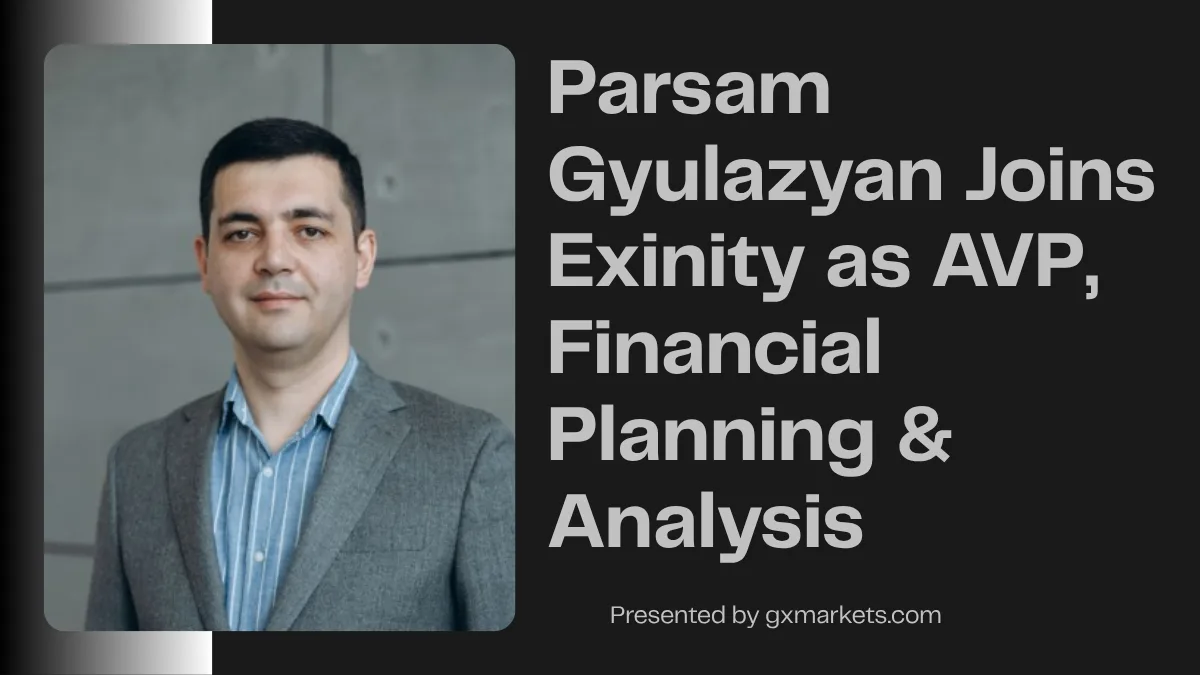
Parsam Gyulazyan has joined Exinity as associate vice president (AVP) of financial planning and analysis (FP&A). The appointment brings senior finance leadership to Exinity, a global fintech group that develops and operates financial brands across traditional finance and decentralized finance. In the role, Gyulazyan will oversee and strengthen the company's budgeting, forecasting, financial modeling and performance reporting, working alongside senior leaders and business teams. His appointment adds to his experience in fintech, financial services and corporate finance.
Exinity FP: What the Appointment Means for Exinity
The FP&A function sits at the centre of how a company plans its money and measures whether its plans are working. For Exinity, which runs several financial brands and offers products across multiple asset classes, that function has to connect results from different parts of the business and turn them into decisions. Gyulazyan's appointment places a dedicated finance leader in charge of that work.
According to the announcement, Gyulazyan will support the company's budgeting, forecasting, financial modeling and performance reporting. He will work with senior leaders and business teams to review results, track key trends and provide the financial information needed for business decisions. These tasks are the day-to-day core of FP&A, and they are what allow management to see early when results drift away from plan.
His responsibilities also include preparing long-term plans, developing management reports and linking financial performance to Exinity's commercial and operational priorities. In practice, this means helping leadership judge which activities are paying off and where resources should be moved. It is a role that looks forward as well as back.
Exinity FP: Parsam Gyulazyan's Professional Background
Gyulazyan has worked across FP&A, corporate finance, controlling, investment analysis and performance management. That mix matters because each discipline looks at money from a different angle. Corporate finance deals with how a company funds itself and allocates capital. Controlling checks that actual results match what was planned and reported. Investment analysis tests whether a project or market is worth the capital it needs. Performance management ties all of this to targets and accountability.
Across these areas, his background includes reviewing business performance, improving forecasting methods and using financial data to support business planning. Those are the skills most often needed when a company operates in several markets at once and needs clear numbers to guide decisions.
Gyulazyan is also a CFA charterholder. The CFA designation is a professional credential in investment analysis and portfolio management, and its curriculum covers financial analysis, investment management, portfolio construction and professional standards. Holding the charter signals a formal grounding in analytical methods and in the ethical standards that govern financial professionals.
Exinity FP: What FP&A Covers in a Multi-Brand Financial Group
FP&A teams do more than produce an annual budget. They analyze financial and operational data, build business scenarios and give management a clearer view of likely outcomes. A group that operates several brands and serves customers in different regions needs this kind of work to compare results across units, review costs, assess new opportunities and decide how capital is spread between products and markets.
The announcement says Gyulazyan will work with finance, operations, technology, product and commercial teams. That cross-functional scope is important. Forecasts are only useful if they reflect what the product, technology and sales teams are actually planning, so FP&A works best when it is in regular contact with the rest of the business.
Typical steps in an FP&A cycle
- Gather data: collect financial and operational figures from each business unit and region.
- Set the plan: agree budgets and targets with business leaders, based on expected volumes, costs and investment needs.
- Forecast: update expectations regularly so leaders see how results are tracking against plan.
- Model scenarios: test how changes in markets, costs or product demand could affect outcomes.
- Report and review: prepare management reports, explain variances and agree corrective actions.
- Feed back into planning: use what was learned to shape the next cycle and long-term plans.
How the Role Compares With Related Finance Functions
Job titles in finance overlap, so it helps to know where FP&A fits. The table below gives a general comparison. It describes typical focus areas rather than the specific structure of Exinity.
| Function | Main focus | Typical question it answers |
|---|---|---|
| FP&A | Planning, forecasting and performance analysis | Are we on track, and what happens if conditions change? |
| Controlling | Accuracy of reporting and cost control | Do the recorded results match the plan and the rules? |
| Corporate finance | Funding and capital structure | How should the company raise and deploy capital? |
| Investment analysis | Assessing projects, assets and markets | Is this opportunity worth the capital it requires? |
Why This Matters for Traders and Clients
Most traders will never work directly with an FP&A team, but the discipline shapes the businesses they use. Sound financial planning helps a company keep its costs under control, invest in its platforms and plan for the regulatory and operational requirements of the markets it serves. Clear reporting also makes it easier for management to spot problems early.
The announcement does not give details of any change to products, pricing or account terms, and this article does not assume any. What it does show is that Exinity is investing in finance leadership as it runs multiple financial brands and develops products for customers in several regions. If you are comparing brokers, it is worth looking beyond headline announcements and checking the things that affect you directly, such as execution quality, costs and the regulatory status of the entity you would open an account with. Our XM Group review shows the kind of criteria we use when assessing a broker.
About Exinity
Exinity is a global fintech group that develops and operates financial brands across traditional finance and decentralized finance. Its offerings include equities, foreign exchange, digital assets, artificial intelligence and Web3 products and services. The group serves customers in the Middle East, Africa, Asia, India and Latin America, operating through international offices and regulated entities, with employees from a range of countries and professional backgrounds.
Looking Ahead
In his new role, Gyulazyan will help connect financial planning with the company's broader growth and operating plans. As Exinity continues to develop products for international markets, the quality of its forecasts, scenario models and performance reports will shape how it allocates resources. The appointment signals that finance leadership is a priority as the group expands.
Risk reminder: trading leveraged products such as forex and CFDs carries a high risk of losing money quickly. Make sure you understand the risks before trading and only use funds you can afford to lose.
Further reading: Foreign exchange market (Wikipedia).
We will keep this Exinity FP report updated as new information comes in.