Laura Laucis Starts New Role as Payment Operations Specialist at Exness
Laura Laucis has started a new role as Payment Operations Specialist at Exness. This article covers the announcement and what the appointment means for traders using the broker.

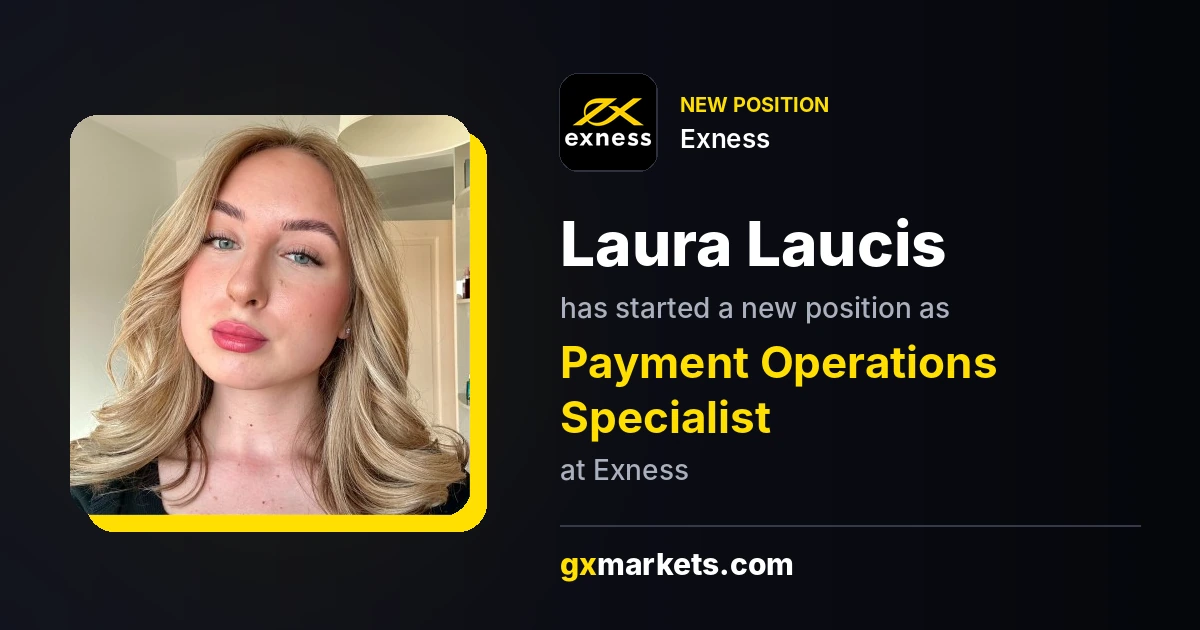
Laura Laucis has started a new role as Payment Operations Specialist at Exness, the multi-asset CFD broker that has operated since 2008. The announcement was published in November 2026 and shares the update on her career move. It does not include details about her specific responsibilities or previous experience, so this article focuses on the appointment in context and on what traders should know about the broker.
What Was Announced
The announcement confirms that Laura Laucis has joined Exness in the position of Payment Operations Specialist. It is a brief update on a professional move rather than a full profile. No additional background on her earlier roles, qualifications or team structure was published alongside it, so anything beyond the job title would be speculation.
Because the announcement is limited in scope, readers should treat it as a confirmation of the appointment and nothing more. Any future statements from Exness about the scope of her work would be the most reliable source for further detail.
Appointment news in the financial sector is often published in short form. Readers who want more context can check official company channels, career pages and public regulatory records where they exist, rather than relying on a single brief update.
What a Payment Operations Specialist Does at a Broker
The title itself points to the area of the business where she works. Payment operations teams at brokers generally handle the flow of money between clients and the company. The exact duties depend on each firm's structure, but the work typically involves:
- Processing and monitoring client deposits and withdrawals
- Coordinating with banks, card acquirers and e-wallet providers
- Reconciling payment records against client accounts
- Working with compliance teams on verification and anti-fraud checks
- Resolving payment queries that the support desk escalates
These functions matter to every trader, even though they rarely appear in marketing material. Smooth payment handling is one of the most visible signs of how a broker operates day to day.
Because payment work sits between clients, banks and compliance teams, small errors can have wide effects. A mismatched transaction can delay a withdrawal, trigger a verification request or create confusion about an account balance. Good processes aim to prevent these problems before a client notices them.
Why Payment Operations Matter to Exness Clients
Exness markets itself on several features that depend heavily on payment infrastructure. The broker promotes instant withdrawals and accepts deposits from a low starting point, with minimum deposits from $10 (or the currency equivalent) on its Standard range. Both features only work reliably when the back-office processes behind them are well organised.
Client money handling is also central to trust. Exness states that it keeps client funds in segregated trust accounts and applies automatic negative balance protection. These arrangements are designed to separate client money from company funds and to stop a client from owing more than the balance in their account. Payment operations staff play a practical role in making sure those policies run correctly on every transaction.
For a client, the practical questions are simple: how quickly does money move, and what protects it along the way? Answering them requires looking at both written policy and day-to-day operations, since a policy only helps if the systems behind it work as described.
Exness at a Glance
The table below summarises the main features of Exness as described in its own marketing material. Conditions can vary by account type, jurisdiction and client status, so check the current terms on the broker's website before trading.
| Feature | What Exness Offers |
|---|---|
| Founded | 2008 |
| Instruments | Forex, metals, energies, equity indices, single shares and cryptocurrencies, all as CFDs |
| Maximum leverage | Up to 1:2,000, with "unlimited" leverage available once certain equity and trade-volume conditions are met |
| Trading platforms | MetaTrader 4, MetaTrader 5 and a proprietary web and mobile suite |
| Account types | Five live account types, from beginner to high-frequency trading |
| Minimum deposit | From $10 (or currency equivalent) on the Standard range |
| Client funds | Held in segregated trust accounts |
| Negative balance protection | Automatic |
| Client support | Round-the-clock multilingual help desk |
When comparing any broker, it helps to read the table alongside the full terms rather than treating it as a complete summary. Leverage and unlimited-leverage conditions in particular deserve a close read.
How Exness Compares With EU-Regulated Brokers
Exness operates across multiple jurisdictions, and the level of protection a client receives depends on which entity they contract with. The broker notes that, unlike EU brokers, most Exness entities are not covered by a statutory investor-compensation scheme. This is an important distinction. EU-regulated brokers generally work under tighter leverage limits and are subject to investor-compensation rules that can apply if a firm fails.
That does not automatically make Exness a poor choice, but it does mean the trade-off is different. Flexible leverage and low entry costs come with a lighter layer of financial safety nets. Traders who want to compare protection levels across brokers can review our XM Group review for another multi-jurisdictional example.
A useful habit is to compare brokers on the same criteria: which entity you contract with, what compensation coverage applies, how leverage is capped, and how withdrawals are processed. Writing these points down makes differences easier to spot.
Risks Traders Should Keep in Mind
High leverage can increase both gains and losses quickly. A position opened at 1:2,000 can move against a trader far faster than one with conventional leverage, and an account can be wiped out in a short time. CFDs are complex instruments, and most retail traders lose money when trading them. Only trade with funds you can afford to lose, and make sure you understand how margin, stop-outs and negative balance protection work before opening a live account.
Trading risk also includes operational factors, such as platform outages, slippage during fast markets and delays in payment processing. Keeping a buffer of funds and avoiding reliance on a single withdrawal route can reduce the impact of these issues.
Checklist for Traders Reviewing Exness
If you are considering opening an account, or simply following developments at the broker, these steps will help you make a grounded decision:
- Confirm the entity you will contract with. Check which Exness company governs your account and which jurisdiction applies to it.
- Read the current client terms. Pay attention to leverage rules, withdrawal policies and any conditions tied to unlimited leverage.
- Check the investor-protection position. Find out whether your entity is covered by a compensation scheme and what that means in practice.
- Test the withdrawal process. Make a small deposit and withdrawal before committing larger sums, to see how the process works for you.
- Choose an account type that fits your style. The five live account types cater to different trading frequencies and experience levels.
- Use a demo account first. Practise with the platform you intend to use before trading with real money.
For a related example of how industry staffing and leadership moves are reported, see our coverage of AvaTrade Appoints Exness Executive Nir Iter as Cyprus Director.
Next Steps and Related Reading
Staff announcements are best used as a starting point. If you want to understand how a broker's back office affects your money, focus on published policies, your own account statements and the support answers you receive in writing.
Traders who also follow commodities may find background useful on precious metals. You can read about the investment side of the asset class in Gold as an investment (Wikipedia).
About Exness
Exness is a global multi-asset financial broker founded in 2008. It offers Contracts for Difference across forex, cryptocurrencies, commodities, indices and stocks, and it operates as a multi-jurisdictional CFD broker. Its clients trade on MetaTrader 4, MetaTrader 5 and a proprietary web and mobile suite.