Ellie Lynch Takes an Institutional Sales Role at IG Prime
Ellie Lynch has been appointed to a new position in the Institutional Sales team at IG Prime. This guide explains what the move means for institutional clients and traders.

IG Prime has announced the appointment of Ellie Lynch to a new position within its expanding institutional sales team. The announcement was made on 4 November 2026. The move reflects the firm's focus on strengthening its offering and deepening relationships with institutional clients, a segment that includes hedge funds, asset managers and family offices.
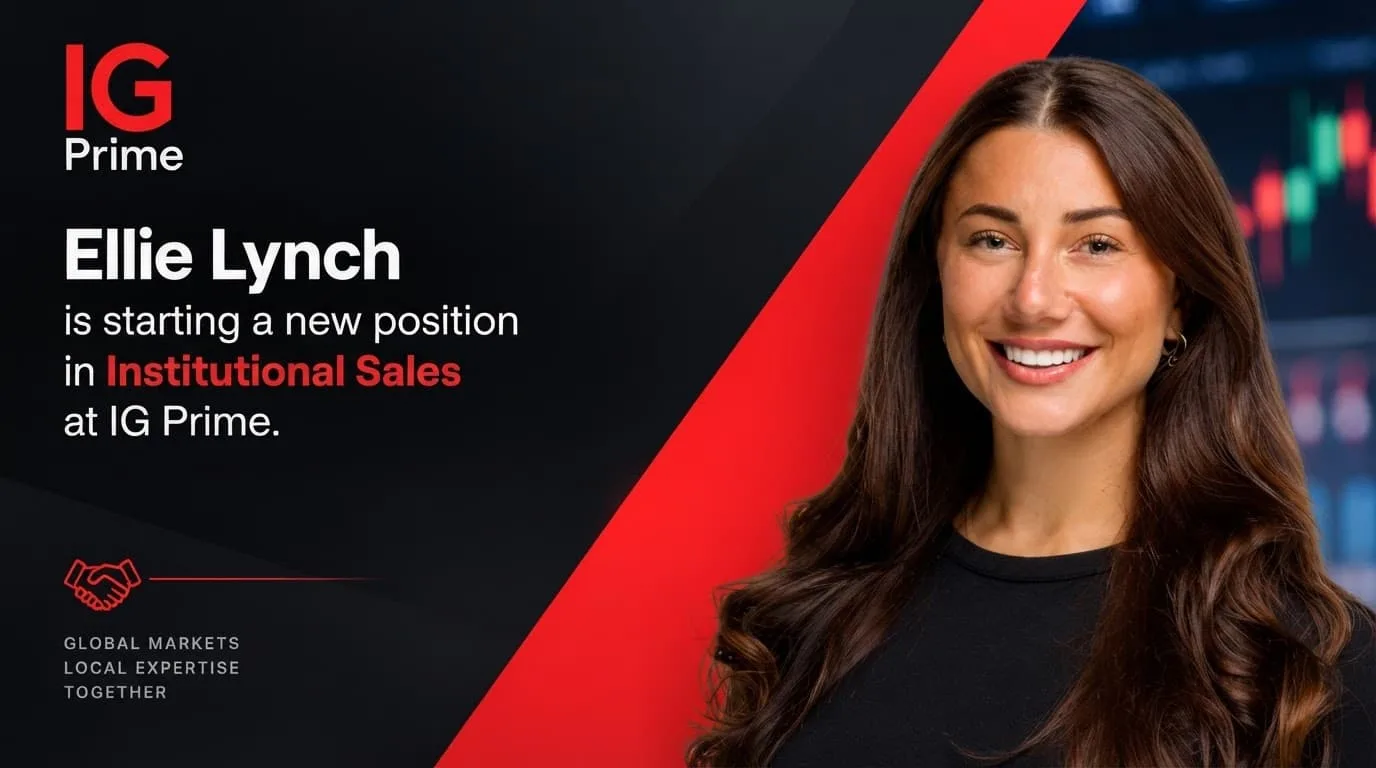
IG Prime describes itself as a provider of prime brokerage and institutional trading solutions. In her new role, Lynch will work on growing IG Prime's footprint among institutional clients, with a particular focus on building strategic partnerships and delivering tailored solutions for sophisticated investors.
Appointments in client-facing teams can reveal where a firm is putting its effort, even when the company does not publish detailed plans. This article explains what the move means, who the team serves and how individual traders can put the news in context.
What the Appointment Means for IG Prime
Institutional sales teams sit at the point where a broker's technology, liquidity and risk capabilities meet the needs of large clients. For a firm like IG Prime, that means turning its trading infrastructure into services that professional investors can rely on over the long term. Adding dedicated people to this area signals that the firm sees institutional business as a priority for future expansion.
The announcement does not set out specific targets or a timeline for the new role, so it is best read as a sign of direction rather than a detailed plan. What it does make clear is that the position sits within an institutional sales team that the company is actively expanding.
The announcement does not list day-to-day duties either. In general terms, roles in client-facing teams of this kind tend to involve understanding what prospective clients need, keeping existing relationships healthy and passing that feedback to product, technology and risk colleagues.
Who Institutional Sales Teams Serve
The announcement names three client types that the role will target. Each has different requirements, which is why institutional relationships are usually handled through dedicated sales coverage rather than standard onboarding.
- Hedge funds typically need fast execution, flexible margin arrangements and reliable access to liquidity across several markets.
- Asset managers often look for operational support, reporting and trading solutions that fit large portfolios and internal compliance processes.
- Family offices tend to value discretion, personalised service and a clear understanding of their long-term investment mandates.
Serving all three groups well requires institutional sales staff who can understand a client's strategy, listen to operational constraints and coordinate with trading, technology and risk teams inside the firm.
For context on how other firms are building similar teams, see our coverage of Robin Ejsmond Frey Joins GCEX as Director of Institutional Sales, Asset Management.
How Institutional Sales Differs From Retail Broking
Many retail traders only interact with a broker through an account opening page or a trading platform. Institutional clients usually have a very different experience, with a named contact, bespoke documentation and terms negotiated around their trading volumes and mandates. The table below gives a general comparison of the two models.
| Area | Retail client | Institutional client |
|---|---|---|
| Onboarding | Standard online application | Due diligence and tailored agreements |
| Pricing | Published account terms | Negotiated around volume and needs |
| Support | General client support | Dedicated sales and relationship contacts |
| Typical focus | Individual trading | Strategy, execution quality and operations |
The exact terms for any specific client will vary, and IG Prime's own arrangements are not detailed in the announcement. Treat the table as a general guide to how the two models usually differ, not as a description of any firm's pricing.
Institutional sales coverage tends to be built around longer conversations, because the broker must understand a client's mandate before any agreement is drafted. Retail onboarding, by contrast, is designed to be quick and standardised.
How the Move Could Affect Traders
Most individual traders will not deal with the the sales team directly. Still, changes in how a broker serves large clients can be felt more widely. A broker that invests in its the sales function may put more resources into liquidity, execution infrastructure and market access, which are the same building blocks that retail clients depend on.
However, the announcement does not promise any change to retail account terms, and traders should not assume that a new hire will alter pricing or products for them. Any improvement in infrastructure would need to be confirmed through the broker's own published terms.
Many retail products are leveraged, meaning a relatively small deposit can control a much larger position. For background on the concept, see Leverage in finance (Wikipedia).
If you are comparing brokers, it helps to look at the whole picture: regulation, execution, account types, costs and the support you can expect. Our review of XM Group is one example of how we assess these factors for a retail-focused broker.
Steps to Understand a Broker's Institutional Offering
If you want to judge whether a broker's institutional business is relevant to your own trading, you can work through a short checklist:
- Check the broker's regulatory status and the entities that provide each service, as stated in its official disclosures.
- Read the account and execution terms that apply to your client type, not just headline marketing claims.
- Ask how support and dispute handling work for your account, and what documentation is required.
- Compare the broker's offering with at least two alternatives before committing funds.
Taking these steps does not require any special expertise. It simply means reading primary sources carefully and checking that the information applies to the account type you would actually use.
About IG Prime
IG Prime is part of the IG group. According to the company, it has been at the forefront of trading innovation for more than 45 years, offering award-winning technology with high-speed execution and access to liquidity. The company also states that it is a FTSE 100 company with a market capitalisation of £3.97 billion, and it points to its balance sheet strength as a reason clients trust the business.
These are the company's own statements and should be checked against current official sources. Overall, the the sales appointment is best viewed as one step in a broader effort to serve professional clients, rather than a signal about retail products.
Regulatory Information
CFD accounts are provided by IG Markets Ltd, spread betting by IG Index Ltd, and share dealing and stocks and shares ISA accounts by IG Trading and Investments Ltd. IG is a trading name of IG Markets Ltd (a company registered in England and Wales under number 04008957), IG Index Ltd (a company registered in England and Wales under number 01190902) and IG Trading and Investments Ltd (a company registered in England and Wales under number 11628764). Registered address: 88 Wood Street, London, EC2V 7QR.
IG Markets Ltd (Register number 195355), IG Index Ltd (Register number 114059) and IG Trading and Investments Ltd (Register number 944492) are authorised and regulated by the Financial Conduct Authority.
Risk warning: CFDs and spread betting are leveraged products and can result in losses that exceed your deposit. Make sure you understand the risks before trading.